Search This Blog

Powered By Blogger

Sunday, July 27, 2014

Browsing in an Old Gazeteer of Northern Illinois Counties


Recently I came across a digital copy of the 1855-56 Gazetter and Directory for the Northern Counties of Illinois.  Have you ever browsed through one of these resources?  It's a great source to find out Who's Who in history of "east pudunk", meaning those old towns and villages.  It also has advertisements of the businesses of the areas that are referenced.  It's almost like an early type of Yellow Pages.  You can find out who the local politicians were, the post office locations and postmaster identities.  Some even have maps showing the locality of government buildings, schools, and the like. Where can you find old gazetteers?  Internet Archive www.archive.org, Mocavo www.mocavo.com, and Google www.google.com are just a few of the online sources.  Libraries that have local history reference sections should have some gazetteers and local directories.

Here's the title page of the Gazetteer that I was happy to peruse: 


Since I live in DuPage County, I wanted to find out who the "Movers and Shakers" were in this locale.

The DuPage County entry as printed:


Notice the location of  the county, that it's origins were a part of Cook County, and that it was organized in 1838.  I was not aware that the first settlers were from Ohio, thinking that they were from a little farther east, like New York or Vermont.  It does mention the German emigrants that came through Pennsylvania, which I did know.  

The description of  the land reads like a real estate advertisement.  Wood land, prairie and fertile soil...who wouldn't want to move here?  Then I stopped dead in my tracks.  The County Seat was located in Naperville????? Oh, yes, there is a nasty history about that.  The County Seat is now in Wheaton.  And, after the Civil War, there were some disputes about relocating the seat. I found the following excerpts from Wikipedia, which we all know is the honest truth (NOT!!!)  Read on...

In 1857, the Illinois state legislature authorized an election to be held to decide the question of whether the DuPage county seat should remain in Naperville or be moved to the more centrally located Wheaton, which was on the Galena and Chicago Union Railroad. Naperville won the election by a vote of 1,542 to 762. Hostility between the two towns continued for the next decade and another election was held in 1867, in which Wheaton narrowly won by a vote of 1,686 to 1,635. At a cost of $20,000, the City of Wheaton quickly built a courthouse to house a courtroom, county offices, and a county jail. The building was dedicated on July 4, 1868.[10]
However, animosity between the two towns continued, and in 1868, as records were moved from the old Naperville courthouse to the new one in Wheaton, Naperville refused to turn over the remaining county records, prompting a band of Civil War veterans from Wheaton to conduct what came to be known as the "Midnight Raid" on the Naperville courthouse. As Wheatonites fled back on Wheaton-Naperville Road, Napervillians were able to secure some of the last remaining records, which were then taken to the Cook CountyRecorder in Chicago for safekeeping. During this time, Naperville was mounting a lawsuit against Wheaton accusing election judges of leaving their posts for lunch during the vote when duplicate ballot stuffing allegedly occurred. As the courts deliberated the fate of the county seat, the records were destroyed in the Great Chicago Fire of 1871. Shortly thereafter, Wheaton was officially proclaimed the county seat.[11]
.wikipedia.org/wiki/Wheaton,_Ill.

I live in the eastern half of DuPage County, and I wanted to browse the text to see what information was written about this general area.  I found three entries:

        The first is a nice description of Cottage Hill, which is present day Elmhurst, Illinois.


Gee, they make it sound like a respite place from the bustling city of Chicago.  Further historical information, again from Wikipedia.....

 a native of Ohio named Gerry Bates established a community on a tract of "treeless land" in 1842.[4]
The following year, Hill Cottage Tavern opened where St. Charles Road and Cottage Hill Avenue presently intersect. In 1845, the community was officially named Cottage Hill when a post office was established. Four years later the Galena and Chicago Union Railroad was given right-of-way through Cottage Hill giving farmers easier access to Chicago.[4] The community changed its name to Elmhurst in 1869.  
wikipedia.org/wiki/Elmhurst,_Illinois

The Township of York is still alive and well here in eastern DuPage County.  Apparently it was organized and fully staffed back in 1855-56, too.  Here's the posting, although small, for York...

 It mentions the name of Gerry Bates, once again, but this time as the post-master of Babcock Grove.  Having lived in another town just west of here, I know that Lombard, IL used to be called Babcock Grove.  And, the famous Graue Mill, located in my village of Oak Brook, is mentioned with the owners name....Frederick Gray.  Members of the Graue family changed the spelling of their last name so that newcomers would not have a problem pronouncing it.  Horace Grant was the owner of a General Store in the area of Fullersburg, which is a historic area along the Salt Creek bounded by current day Hinsdale and Oak Brook. Supposedly, Mr. Grant was a cousin of General Grant.

Lastly, I found the descriptive information for Downers Grove, which is still a strong community today.


Once again, consulting Wikipedia, I find what has been contributed to this site regarding the history of Downers Grove :

Downers Grove was founded in 1832 by Pierce Downer, a religious evangelist from New York. Its other early settlers included the Blodgett, Curtiss, and Carpenter families. The original settlers were mostly migrants from the Northeastern United States and Northern Europe. The first schoolhouse was built in 1844
Wikipedia .org/wiki/Downers Grove

There were no advertisements for the businesses in these three areas. However, larger, densely populated towns like Rockford, Naperville, Wheaton, etc. had many advertisements printed in this gazetteer.  It fun to browse through those and see what kind a businesses were necessary to keep the communities functioning.  

So, when you want to find out who was running the show in some of these old towns and villages , consult an old gazetteer.  They have been around for a long time, and can still provide some bits of information that your I Phone won't give you.  Go "old school" in your research.  It's fun.

Sunday, July 20, 2014

Eugene W. Farrar - First White Person Born in DuPage County Passes Away in 1921

I enjoy reading the Journal of the Illinois State Historical Society.  There are some fabulous articles written in these volumes. This week I browsed Mocavo @ www.mocavo.com.  There are so many digitized volumes of this Journal.  Information right at your fingertips.  History is just so easy to access with Mocavo.
Illinois State Historical Society Journal, Volume 14, accessed 16 July 2014, www.mocavo.com
Searching for articles that mention DuPage County, I came upon this article:

Farrar, Eugene W. , Editorial, Journal of the Illinois State Historical Society, 1921, Volume 14, page 218
How interesting that this man had this honor attached to his name....first white child born in DuPage County.  In 1835, there wasn't much in the way of paved roads, fast food restaurants and bustling suburban life.  More likely, it was dirt paths, prairie plants and a few Indians left over from the aftermath of the Black Hawk War.  The white man had just started purchasing the land from the government and setting up their homesteads.  

Here is an artist's rendering of the Farrar property in Downers Grove, IL, which was found on Ancestry, www.ancestry.com

Ancestry.com. U.S., Indexed County Land Ownership Maps, 1860-1918[database on-line]. Provo, UT, USA: Ancestry.com Operations, Inc., 2010.
Original data: Various publishers of County Land Ownership Atlases. Microfilmed by the Library of Congress, Washington, D.C.
Searching the Federal Census reports from Ancestry, www.ancestry.com, I find that this homestead was located at 48 West Maple Street which was in Downers Grove at the time of the enumerations. However the property is located in what is present-day Clarendon Hills,  IL, a suburb just west of the Downers Grove border.  I found Mr. Farrar and his family listed in the 1870 Federal Census :

1870 U.S. Federal Census, Farrar, Eugene W., Downers Grove, IL,  Ancestry www.ancestry.com, accessed 15 July 2014
Note that he was an employee of the railroad, had a wife (noted as Jane, which differs from the article that referenced his death) and three small children.  Perhaps Martha was going by her middle name, Jane.  Who knows?  Further images of the Federal census show Eugene in 1880, 1900, 1910 and 1920 (1890 Census was burned) living at the same location...48 West Maple Street, Downers Grove, IL.

1880 Federal Census, Downers Grove, IL

1900 Federal Census, Downers Grove, IL

1910 Federal Census, Downers Grove, IL

1920 Federal Census, Downers Grove, IL

Ancestry also has Mr. Farrar referenced in a family tree which was posted by one of their subscribing members (omitting the name to preserve privacy), which lists his parents, wife and children :


Mr. Farrar passed away in 1921, according to the article in the Journal, so he should not appear in any further census lists.  When searching for his place of burial, I found him listed as being interred in the Oak Crest Cemetery, situated in Downers Grove, IL.  Here is the memorial placed for him, by contributor BB and Farrar and Related Families...

Farrar, Eugene W., FindaGrave www.findagrave.com, accessed 17 July 2014
Since Eugene Farrar was born in 1835, he could have been involved in the Civil War.  The article from the Journal indicates that he did participate.   In 1861, when the war started he would have been about 25 or 26.  Searching Fold 3, www.fold3.com, because it has the most military records of online databases, I found his pension index card:

Farrar, Eugene W., Pension Index Card, Fold3 www.fold3.com, accesses 18 July 2014
It appears that Mr. Farrar applied for a pension as an invalid, and his wife applied for her pension as a widow.  The referencing application and certificate numbers can guide you to the proper documentation.  I found him listed in the 1883 List of Pensioners from the State of Illinois, having begun his $8.00 payouts in June of 1882. This I found on the Mocavo website.

Certificate 210,241 Farrar, Eugene W.,  Mocavo, www.mocavo.com, accesses 18 July 2014

Looking back at the military records of Ancestry, www.ancestry.com, I find Mr. Farrar listed in the Civil War Soldiers Records and Profiles, 1861 - 1865 :


Farrar, Eugene W., Civil War Soldier Record, Ancestry, www.ancestry.com, accessed 18 July 2014
Well, it looks as though we have found lots of information on Eugene W. Farrar, first born white child in DuPage County.  But is this all there is?  Heck no!!!  We have not even begun to uncover his life story.  Don't forget that he owned land, which means that there would be records for that and he had to pay taxes.  He could read and write, and there were a few schools in Downers Grove, so he would be listed in those records.  He was a man of stature in the  community, and would have been mentioned in the local newspapers.  He was  probably a man of God, and his records would have been listed within the church registers.  He married Ms. Carpenter, so the record of his marriage would be in the  County of Dupage Marriage records.  Since he served in the Civil War, there are the records of the G.A.R.  which was very active in Downers Grove and surrounding areas. He could have had a will and that would have been on record with the County, or if not, then a probate record could have been recorded with the County.   The list goes on and on.  But, alas, I only have so much time to write about his life story in this blog.

When researching the life of someone you "Stumble Across", be sure to search under every rock and stone.  Stories of the past help to paint a picture of the lives of those who suffered hardships before our time.  Before there were highways, there were forests and paths to explore.  

Saturday, July 12, 2014

1956 Tragedy : Four family members die in plane crash

Section H Lot 24  Ward family of four, all deceased 2 January 1956


I have taken photos of over 10,000 graves for the Bronswood Cemetery here in Oak Brook, Illinois.  Today I was adding grave photos to the FindaGrave website ( www.findagrave.com ) for this cemetery.  When I came upon a family of four, I paused and looked at my notes that I had transcribed from the original burial log, which is held in the cemetery office in a vault.  The owners of the cemetery had allowed myself and my assistants to view these logs in the past, and we made careful notes from what we could glean from the records.

The Ward family, buried in Section H Lot 24, holds the remains of six persons.  Four of them passed on the same day....January 2, 1956.

Bronswood Cemetery Burial Index, Oak Brook Historical Society website, www.oakbrookhistory.com


  As I gazed at my notes, I read "family plane crash".  My curiosity got the best of me.  I finished adding photos for the burials of Section H, then headed on-line to discover what I could about this unfortunate family disaster.

I use several on-line websites to discover old newspaper articles.  My most profitable search came from My Heritage ( www.myheritage.com ),  There I found several articles about this family and the terrible incident that took their lives.  Newspapers from across the nation had reported on this tragedy.
Rockford Morning Star, Rockford, IL, 1956 Jan 3, page 1


Racine Journal Times, Racine, WI, 1956 Jan 3, page 1


The four members of the Ward family were visiting relatives in  St. Louis, Missouri, during the holiday season.  They were in a small Cessna 170, headed back to the Chicago suburbs, when it crashed in a farm field before the family could reach their home destination.  Reports reveal that the fog was thick that day.  Paul Ward, his wife Harriet and daughters Barbara and Sharon were killed when the plane burst into flames after crashing into a field.

Such is a sad story to come upon when recording the burial records in a cemetery.  To know that this family was killed after visiting relatives during the holiday season is very sad.  They are laid to rest with two other family members,  Ruby and Orie Ward.  Both passed away within 8 to 9 years of their younger relatives.  It must have been a very sad day for them to bury four of their family members on the same day in the dead of winter in 1956. Who could have predicted this sorrowful end?

The next time I get a chance to visit Bronswood Cemetery, I'll be sure to stop by the  Ward family plot and say hello to the entire family.  It was a pleasure to take time to learn about their story, even though it was a tragic end for them.  To leave this earth together must have been something that they did not expect.

Ward Family stone, Bronswood Cemetery, Oak Brook, IL


Saturday, June 28, 2014

Discovering an Inventor in the Graveyard : Following a Paranormal Hunch

A few years ago, I volunteered, along with two assistants, to attempt to index and photograph a rather large cemetery in the southern half of Oak Brook, Illinois, called Bronswood.  I noticed that the county genealogical society had completed this task for most of the cemeteries of the region, except this one. Why had no one indexed this cemetery?  Maybe it was because this cemetery is still open and expanding. Or, maybe it was because the cemetery already had over 10,000 "residents", and was still growing.  Whatever the reason, I had decided that no task was too big for me. Hahahahaha.  It took us over 2 years to index and photograph what we could, which included 10,300 burials at that time.  The cemetery has since been sold, and is ever expanding again.  I had an index posted on the Oak Brook Historical Society website, www.oakbrookhistory.com, along with all of it's mistakes and inadequate information...another task to take care of at a later date.  Currently, I am adding my photos for these interments to Find a Grave, www.findagrave.com.

Not too many people know that on occasion, I have a sixth sense about things...call it a sort of paranormal intuition.  When in cemeteries, I get a tapping on my shoulder...a hunch...a distraction...a calling from some gravestones.  I think that it is someone who has passed on, trying to get my attention to ask me to stay for a while and talk with them. I know, creepy, right?  There are those persons who have a story to tell, and they want me to listen.  So, I do.

Such was the case when I was indexing section H in this cemetery.  I came upon a memorial stone dedicated to Mr. Adolph Rebernak.  This name might not mean much to you, but it will when I tell you about Adolph.  Have you ever used a cleaning product named Endust?  What about using a squeeze sponge mop made by O'Cedar?  Of course you have, haven't you?

Bronswood Cemetery, Section H Lot 76


Adolph Rebernak was the inventor of  the squeeze sponge mop, Dri-Glo and Endust.  Now, you might be thinking, "this gal is really nuts" and that is your right.  But read on and learn a bit about this man who wanted me to listen to his story.

Mr. Rebernak passed on February 7, 1990.  He had a rather nice obit written about him.  Here is what I found in the Chicago Tribune :


As you can see, this guy had quite the background in education and profession.  Notice that it mentions his patent for the sponge mop that was manufactured by O'Cedar Corporation.  Here is more information about this mop and it's patent :


patent for the foldable compression mop


patent drawing for the foldable compression mop by A. Rebernak
Mr. Rebernak did not stop there.  No way.  He decided to make some revisions to his mop.  He made it an angular sponge mop.  Probably easier to handle for the person using the mop and less taxing on the back.  Here is the patent information for this new, and improved mop :
information found at patents.google.com

Patent 3,038,188 has a file of drawings regarding the sponge mop invented by Mr. Rebernak :


I never knew it took this much technology and thought to come up with such an idea.  Remember the O'Cedar commercial jingle....O'Cedar makes your life easier?  Well now you can thank Mr. Rebernak each time you grab a sponge mop and put it to use. Just think of how many lives he made "easier" by inventing this mop, along with the cleaning products.  I find myself singing the jingle, "O'Cedar makes your life easier", each time I grab a mop, and think of Mr. Rebernak.

Now, who else from this cemetery will want to tell their story to me?  I'll let you know....


A little more information about the O'Cedar Corporation, taken from it's website, www.ocedar.com :

Our History

The Channell Chemical Company started as a manufacturer of waxes and wood polishes, which were sold door to door in the early 1900s. One of the main ingredients in the polish was cedar leaf oil, which led to the product being called “O-Cedar Polish.” As the company expanded, so did the brand awareness of O-Cedar, and the name just stuck!

O-Cedar Makes Your Life Easier!®

We’ve dedicated our 100-year history to taking the “work” out of housework with a constant focus on innovation. We were the first to produce a self-wringing mop, to market the first angle broom, and to introduce the first spray mop to offer both disposable and machine washable microfiber pads! 
Plus, each and every one of our products is designed to help you get the job done quickly, easily and with confidence.


Tuesday, June 17, 2014

My Father's Life Story : What Can On-line Research Tell Me That I Didn't Know About Him

I knew my Father, Frank J. Bognar, Jr.,  for almost 46 years before he passed away in the early Spring of 2002.  He was a major influence in my life.  Thinking that I knew everything about him, I decided  to find further information about him on the Internet.

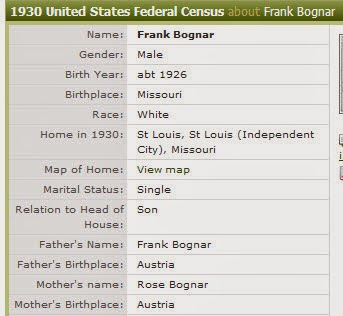
As with most people searching for their heritage, I did a very basic and wide search on Ancestry.com at www.ancestry.com .  The first two results were the 1930 and the 1940 U.S. Census.


No new or surprising information was revealed from these two census listings.  In 1930, the home address was mentioned as 1940 Burd Avenue.  In the 1940 census, the home address was listed at 812 Salisbury Street. Neither home is currently standing.  

Next, I searched on Fold3 at www.fold3.com .  His name appeared in the WWII U. S. Navy Muster Rolls, 1938-1949.  He was aboard the U.S.S. Takanis Bay CVE89.  This page shows the date of his transfer from the escort carrier to the USN Hospital in Seattle, Washington,  This is something that I did not know...just having his date of transfer from ship to hospital is something that I can add to my research, and reference that date when searching for his medical records while in the U.S. Navy. He is listed on line 7, as a Machinist Mate 2nd Class, along with his service number


Fold3 has the muster rolls for the U.S.S. Takanis Bay CVE89 from 1944 through 1946.  Dad's name appears on each muster prior to his transfer to the USN hospital.  

Next, I used Mocavo at www.mocavo.com , a free website for researching genealogy.  They show the Social Security Death Index listing for my Father.  They also mention that there is a memorial listing for him on Find A Grave at www.findagrave.com . No new information for me here.


Family Search at www.familysearch.org  also has the same SSDI and 1940 Census return that the previous websites have in their search results.

My Heritage at www.myheritage,com  repeats the previous results : 1930 and 1940 U. S. Census returns, Find A Grave memorial, and SSDI listing.

GenealogyBank at www.genealogybank.com has the obituary for my Dad from the St. Louis Post-Dispatch, March 2 and 4, 2002 issues.  I do have several copies of this in my family records.


I turned to the Veterans Administration Grave Locator at http://www.cem.va.gov/, and found that Dad was listed correctly with their database, which simply repeats what was in the search results from previous websites.


In addition, the St. Louis Archdiocese http://archstl.org/cemeteries/ has a grave location search engine that helps to find the location of each burial in the cemeteries of the archdiocese, and the ability to reveal what persons share the same burial plot as the deceased.  Here, both of my parents are listed being interred in Section 17A Lot 0129, along with their dates of burial.  


Both People Finders at www.peoplefinders.com and People Smart at www.peoplesmart.com have correctly listed Dad as being deceased, and both mention my Mother as being related, as well as his last location of residence.

World Vital Records at www.worldvitalrecords.com shows a database search result from their public records index.  Showing the last three addresses where my Dad lived, it also includes phone numbers, and naming my Mother as his relative. Of course, there is no new information for me here.


Tribal Pages at www.tribalpages.com doesn't result in any new information on my Dad's life, however, it does show a listing for my grandfather, Frank Bognar, Sr., and his first wife, Anna Springer.  This is a new avenue for my research into that family lineage. But that is for another time.

Conclusion  for now :  The transfer date of my Father from the U.S.S. Takanis Bay to the USN hospital in Seattle, Washington, has been the only new piece of information that I have found during this attempt to update my Dad's story.

Ancestry and it's affiliates are having some server problems this week.  Unfortunately, it has interrupted my on-line searches with additional websites that I wanted to feature here.  There might be a lack of research and browsing this week due to this problem.  With a little luck on their end, this could be resolved shortly.  In the meantime, making good use of other history sources and libraries may prove to be beneficial.  Happy searching to all.

Monday, June 9, 2014

The Life of an Inventor : Lavonious Kenworthy Wynn, OR Don't Believe Every Family Story to be Correct

In some families, there is usually a child that is named for an ancestor; be it a parent, grandparent, great grandparent, or other person that family wished to remember and honor.  My late father-in-law was named Kenworthy Henry Reif.  I knew that his grandfather was Henry Jacob Reif, so there is the repeated "Henry".  But, I did not know where "Kenworthy" had it's origin...was there someone of that name in the family?

After months of working on my husband's family history, I decided to do what I do best....think outside of the box, and work outside of the crate.  This type of research never fails me.  I always come up with something, and indeed, this time I uncovered someone with the name of Kenworthy.

I knew that great grandmother Eliza Hessler Reif had a sister, Emma.  But that was as far as I had gotten into the Hessler family.  Searching  the Illinois State Marriage Index Database, I came across the marriage of Lavonious K. Wynn - Emma Hessler in 1888.  Hmmm.  And the marriage occurred in northern Illinois, in Whiteside County.  Hmmm.  Well, this certainly looks like it could be interesting.  Now I have yet another name to research. But, this wasn't just any person.  It was THE person that I needed to follow through the many records available on-line.

http://www.ilsos.gov/isavital/marriageSearch.do

Sterling Gazette, 1888

Taking this information, I searched on Ancestry.com for Mr. Wynn.  The first result came from the Illinois Deaths and Stillbirths Index, 1916-1947.  

http://search.ancestry.com/
Lavonious Wynn was born in Ohio, and died and was buried in Sterling, Illinois.  He was a widower in 1946 at the time of his death.  His occupation is listed as President of a Laundry Company.  This is little more information than I had before, but what I found on the rest of the page made me jump.  There were a few suggested records that Ancestry.com thought might match this gentleman :


Do you see what I see?  L. KENWORTHY Wynn...... Here is the Kenworthy in this family that I was looking for, listed in the 1910 U.S. Federal Census.  I clicked the link, and BINGO, Lavonious Kenworthy Wynn was married to Emma, living in Sterling, Illinois.

Apparently, my father-in-law was named after his great uncle, brother-in-law of his grandmother, Eliza Hessler Reif.  He must have been an important person in the family to be honored over everyone else in the family when it came to naming my father-in-law.  Now that I found him, I needed to discover what made him so special.  Back to the list of on-line databases that I frequent, I diligently searched for Mr. Wynn.

Lavonious was too young to serve in the military in the Civil War, but he may have served in later years. I searched Fold3.com to uncover more data results.There were no military records, but he was listed in a Cleveland directory of 1880, salesman for F. Bassett Company.  Mr. Wynn did appear in city directories of Des Moines, Iowa from 1892 to 1904.  He resided at The Iliad Hotel, which is no longer standing.


In addition, the name of  L. K. Wynn in the Fort Wayne Journal Gazette, in the 1914 September 7 edition, page 13, volume 38, number 113.  A full page is dedicated to the proof of business prosperity in America, with highlighted comments by leading business men in the United States.

http://www.fold3.com/image/257361646/

My Goodness....it appears Mr. Wynn was a business owner in Sterling, Illinois in 1914...Black Silk Stove Polish Works.  More to research.  How did he get from being in Des Moines in 1904 to Sterling in 1914 as a business owner?

Newspapers are my favorite resource for researching into past lives.  I usually find very interesting information that is not noted in vital records.  ChroniclingAmerica.loc.gov, NewspaperArchive.com, Genealogybank.com and Newspapers.com are my favorite websites for newspaper research.  There are so many others, far too many to name.  For ephemera, I search Mocavo.com.  Additional searching may include Archive.com and InternetArchives at archive.org.

According to a 1963 obit of a nephew of L. K. Wynn, Lewis Wynn,  brother of L. K. invented the polish, but L. K. operated the company, as he had much more experience in sales and marketing. Lewis Wynn passed away of cancer at his home in October of 1904.


Many ads for the Black Silk Stove Polish product were found in so many newspapers.  Here are a few from 1910 posted in the Bemidji Daily Pioneer, Bemidji, Minnesota :


The trademark for the Black Silk Stove Polish was first used on October 9, 1909.  On November 23, 1909 a U. S. Federal Trademark registration was filed for the logo pictured here :

 trademark serial number of 71046083,  currently expired
Note the trademark had been renewed in 1950, as Mr. Wynn passed away in 1946.  Mr. Prescott took over the Black Silk Stove Polish Works in Sterling, Illinois. This trademark became expired on November 3, 1992.

In the Annual Report of the Commissioner of Patents for the Year 1903, Mr. Wynn is listed as having applied for a patent on a cabinet : 

 Friday, January 1, 1904  


Publication: Serial Set Vol. No.4607;  

A patent application was noted in Google.com/patents for Mr. Wynn.  It included an image, dated January 25, 1927, patent number 1,615,319,  of the container product sketch which was submitted for the patent : 


An article from  the Rockford Daily Gazette featured L. K. Wynn and his Black Silk Polish :

Date: Saturday, September 23, 1911  


Paper: Daily Register Gazette (Rockford, IL)  


Page: 11

In other articles, Mr. Wynn was listed as a member of the Executive Committee of the Illinois Elks Association in 1916. The Sterling Illinois Industrial Association, organized in 1907, selected L. K. Wynn as chairman of the committee on Home and Foreign Industries. 

My husband had repeated a story to me, to the best of his recollection, years ago.  It was something about a grandfather or great grandfather who had invented a "shoe black", or black shoe polish, and that a patent had been obtained for the product.  I had dabbled a bit into his ancestors' lives, and found that there were a few German shoemakers, German carpenters, German house painters and German farmers. But, I found no record of a patent for black shoe polish with a connection to this family.

I guess the story became skewed, and the black shoe polish was actually Black Silk Stove Polish.  And, it was not invented by Lavonious Kenworthy Wynn, a great uncle....not a great grandfather, but his brother, Lewis Wynn.  Nevertheless, it is an interesting story, to say the least.