Search This Blog

Powered By Blogger
Showing posts with label Census Records. Show all posts

Sunday, February 15, 2015

The Last Will and Testament of Gottfried Hechtner : Does Eliza Get Snubbed?

Last year I was researching a line in my husband's family tree, The Hechtner Family.  With today's technology, I was able to make a digital copy of the last will of Gottfried Hechtner.  He is the 3rd great grandfather of my husband.

Gottfried was born about the year 1800 in Prussia.  He came to America in the springtime of 1854, with his wife, Mary, and 6 children.  He made his home in Bureau County, Illinois.

Elizabeth Hechtner, fifth child of Gottfried and Mary, married Gottlieb Hessler in Bureau County on May 31, 1860.  Mr. Hessler was a boot and shoe cobbler by trade.  Elizabeth (Eliza on many documents) and Gottlieb became my husband's 2nd great grandparents.  They lived comfortable enough to be listed on several Illinois County Tax Enumeration Lists (1870 and 1880).

Eliza had siblings : Frederick, Mary, Henrietta, Sophia and John.  Their mother, Mary (Kittendorf) Hechtner, passed away in 1862.  Gottfried moved into the home of his son, John Hechtner, in 1861, and lived there until his death.

At the age of 72, Gottfried filed his Last Will and Testament in Bureau County, Illinois. It was dated and filed on May 20. 1872.  He died in June of 1873.

Here is a digital copy of the hand-written will :


State of Illinois, County of Bureau, Illinois State Archives, accessed 2012 5 May.
As I reviewed the document, there appears to be somewhat of a mystery.  Every child, except Eliza Hessler, was to receive one hundred dollars.  Eliza was to receive five dollars.  Why?

Son, John Hechtner, was also to receive whatever worldly goods and belongings were left, due to his kindness in furnishing his father a home in his later years.  

So let's look at what the lives of Eliza and her siblings were like about 1870.  Eliza and her husband, Gottlieb Hessler were living in Sterling, Whiteside County, in Illinois.  As stated before, this couple had an income where they were listed on tax lists, instituted to help pay for the Civil War, which was very costly to the nation.  They had 2 daughters in 1870, Eliza and Emma.

Frederick, oldest of the Hechtner siblings, was living in Muscatine County, Iowa in 1870. He and his wife, Sophia, had 5 children.  He was a farmer and two farm hands were living with the family. According to the US Census data, his land was worth $800 and personal property total estimate was $2000.  He was a Civil War veteran.

Mary, oldest daughter of Godfried, was living in Bureau County, Illinois, with her husband, August Schultz, and their two chilcren, John and Henrietta.  August was a farmer, and his personal property estimate was about $450.  Not doing as well as her brother, Frederick, Mary was still closeby her father's residence.

John, second son of Godfried, was living in Bureau County, Illinois, with his wife, Elizabeth, and their 4 children :  Mary, Emily, John and Eliza.  John was a farmer, and his land was valued at $9,600, with a personal property estimate of $2500.  He seems to be doing quite well for a man of his age. His farm was located 5 miles Northwest of Princeton, IL.

Daughter, Henrietta, was living with her husband, Francis Frank in Bureau County, IL with their three children, according to the 1865 Illinois State Census.  No value of land or personal property was listed on this census.  Francis was a boot and shoe cobbler who worked alongside his brother-in-law, Gottlieb Hessler in Whiteside County, IL in 1860.  His real estate was estimated at $1500 and personal property valued at $500. Gottleib's personal property was worth only $25 in 1860.
Something happens to dissolve the marriage of Henrietta and Francis, as she remarries in 1872 in Rock Island County, Illinois, to Frederick Worth. In 1873, they were living in Iowa for the birth of their son. The Iowa census does make note that Frederick had been out of work for 4 months, due to a physical ailment.  

Sophia, youngest daughter, was married to Frederick Deadrick in 1861 in Bureau County, Illinois.  By 1870, they were living in Iowa. Frederick became a farmer in Poweshiek County, Iowa, with a land value of $2000, and personal property value of $500. They had four children at that time.  

So, with these financial comparisons between the Hechtner siblings, I guess that Eliza and her husband, Gottlieb Hessler were doing a bit better than the others.  Although her brother, John, cared for his father in the latter years of his life, he did have a greater value of property than the rest of the siblings. Eliza and Gottlieb had moved to Otoe, Nebraska before the turn of the century.  Their daughter, Eliza Hessler had married Henry Reif in 1885, son of Georg and Fredricka Reif of Stephenson County, Illinois.  Henry became a baker, and by 1890 they were living in Nebraska.  Eliza and Gottlieb Hessler probably moved that same year with their daughter, son in law and new granddaughter, Hazel Reif.  They lived out the last years of their lives there in Nebraska, Eliza passing away in 1908 and Gottlieb passing away in 1907.  

My guesses as to why Eliza inherited 5 dollars in contrast to the 100 dollars to each of her siblings :

Godfried Hechtner maybe felt that Eliza was well taken care of with Gottlieb's Shoe and Boot business, OR

God forbid....there was a falling out between Eliza/Gottleib and her father for some reason.  Remember that the first husband of Henrietta Hecktner, Francis Frank, was in business with Gottlieb in Sterling, Illinois, in the cobbler trade.  And then there was another marriage for Henrietta, without a reasonable explanation of what happened to Mr. Frank.  Henrietta had those children to take care of.  There could have been something that put a wedge between father and daughter that left hard feelings.  Who knows?  

My next step : browse newspapers, business papers, other records to see what may have occurred in the Frank family that caused a split.  Let's hope there is not a dark side to this story.

Monday, October 27, 2014

The Mysterious Death of Lake Ransom : Murder or Suicide?

Daily Inter Ocean, Chicago, 13 Feb 1882


The Chicago Evening Journal reported the Hinsdale tragedy...Mr. Lake Ransom, resident of 428 South Lincoln Street, was found dead by the side of the street on the morning of February 11, 1882 at the intersection of First and Lincoln Street.  Did he commit suicide, or was he the victim of a brutal murder?  The case has never been solved.  Let's look at the facts and review the investigation.

Lake Ransom was born on 5 June 1844 in Windsor City, Vermont, to Daniel and Lucy Edson (Lake) Ransom.  He was the descendant of Richard Ransom who served as Captain of the Connecticut Militia under Lt. Col. E. Storrs during the Revolutionary War.  Lake Ransom was a member of the Sons of the American Revolution.

Daniel and Lucy Ransom had moved their family to Jo Davies County, Illinois by 1860.

Lake Ransom had served his country in the Union Army during the Civil War, in the 12th Vermont Company B unit.  He was discharged in 1863.
www.Fold3.com, Ramsom, Lake; 12 Regt. Vermont Infantry

He and Lucy Jane Bacon were married in Boston, Massachusetts on 25 December 1866.

www.familysearch.org, Massachusetts Marriages; Lake Ransom, Boston, 25 Dec. 1866
  

Lake was a General Sales Agent for a reaper company, the D. M. Osborne Company, which had a branch sales office and warehouse in Chicago after the Civil War.  According to the Western Massachusetts History , Volume 4, 1636-1925,  Lake Ransom was born in South Woodstock, Vermont, and he moved West.  He was a manager of the western division of the Osborne Harvester Company, in which he spent the majority of his career.

www.Mocavo.com, Chicago City Directory, 1867; Lake Ransom, D. M. Osborne & Co.

Mr. and Mrs. Ransom had moved their familly to Hinsdale, Illinois, and took up residence at a fine home located at 428 South Lincoln Street.  The family appears in the 1870 and 1880 US Federal Census, at this address.

www.ancestry.com, Ransom, Lake, Hinsdale, Illinois, 1870

The Ransom family grew, and by 1880, consisted of five children : Albert, Charles, Clara, William and Louis.

FRIDAY EVENING, 10 February 1882

 Two shots were heard in the evening by a resident of Hinsdale, Mrs. J. W. Webster, who was waiting for her children to arrive home after spending the evening with neighbors.  She estimates it was about the time that the 10:30 p.m. train from Chicago had arrived at the Hinsdale depot. Charles Hinds said the he also heard a shot coming from the area in the evening as he was standing in front of the residence of Mr. Clark, who lived on First Street.

 Mr. Ransom was in the habit of riding the train to and from Chicago. He had been employed as bookkeeper for the Osborne Company for eighteen years until a month before the incident.   He usually rode the late train daily, and his family expected him home shortly after that time.  According to the Chicago Inter Ocean, the train conductor did not recollect him, nor did the other riders remember him leaving the train at the depot.  He could have rode in the smoking car, and departed the train at Lincoln Street, where the head of the train stops, to be nearer his home and he  could reach it sooner.   His wife waited for him until midnight, never to see him walk through the door of their home.

FINDING THE BODY

The body of Lake Ransom was found just before 7:00 a.m. on Saturday, at the corner of First and Lincoln Streets, just two blocks from his residence, and one block from the train depot.   Mr. Shannon, Mr.  A. M. Weir and Mr. J. W. Russell  take the morning train to Chicago. On their walk to the depot, they had observed the body, cold and rigid, laying on the back, next to a tree and the boarded sidewalk.  A hat was laying on the sidewalk, near the feet of the victim.  A revolver was found laying on the sidewalk, with two of the chambers empty. There was also a bag of shot found on the street near the body. The head was laying in a pool of blood, with a bullet hole to back of the skull.  Blood was trickling from the ears and nose. Part of the clothing near the arm and chest was smoldering.  As a crowd of residents surrounded the corpse, a neighbor hustled to the home of the victim and had broken the news  to Mrs. Ransom, who rushed to the scene and she was horrified at the state of her husband.  The body was removed by the police magistrate and officers to the Town Hall. Cornoner Cotton, of Turner Junction, was summoned by telegraph.


THE INVESTIGATION BEGINS

 A large hole was found in the left arm of the garments, which still smoldered as if burned.  The flesh underneath the layers of clothing was blackened and blistered, as if burned. Perhaps that was a point of contact with a gunshot, however, no bullet or wound had been found.  The neck tie was still around the neck, but the collar had been pulled from the shirt.  The vest had been unbuttoned, and the familiar gold watch on a chain was missing from the body.  The watch had been presented to the victim by the employees of D. M. Osborne, and he never seemed to be without it, until now.  The pants pockets had been turned inside out, and the wallet of the victim was not on the body.

A bullet hole to the head, just behind the left ear, appears to have been the fatal shot that ended the life of Lake Ransom.  A large amount of blood and brain matter had come from the wound.

 The Hinsdale police officers searched the general perimeter of the incident and found cards and letters from the deceased strewn across the railroad track area.  The wallet of the victim was found nearby on the railroad track about a block away, completely empty.  Other cards belonging Mr. Ransom were found near the train depot.

Was the bag of shot used to knock Mr. Ransom senseless?  Or thrown to distract him while he was attacked and murdered?  Did he shoot himself once, unsuccessfully in the torso, and then again, successfully in the back of the head?  Would he have emptied his own pockets and tossed his personal papers and empty wallet?

Detectives Wiley and Elliott were hard at work trying to solve the tragic event.  Several tramps were found in the vicinity of the train depot, and they were arrested for questioning, but to no avail.

THE THEORY OF MURDER

During the investigation, many people were interviewed :

Charles Cook, while visiting Western Springs on Friday afternoon, noticed vagrants shuffling along the railroad tracks headed for Hinsdale.

There were rumors, but no concrete evidence, that the tramps were actually at, or near,  the train depot in Hinsdale at the time of the arrival of the 10:30 p.m. train.

It was thought by the Coroner, that Mr. Ransom most certainly would have had some money on him on his way home from Chicago that Friday evening.  However, when the body was found on Saturday morning, there was no money or valuables on him. And, his watch and chain were missing. The Coroner also raised the thought that Mr. Ransom could have killed himself, and the tramps could have taken his valuables when they found his body in the late evening.

Dr. Fitch, brother-in-law of the Mr. Ransom, said he refused to believe that it was a case of suicide.  He believes that there was no reason for his relative to end his life, stating that he had been an honorable character in the community. His family relations were perfect. Though he severed his employment with D. M. Osborne company the month prior, he had ample resources, and he spoke of starting a business for himself in short order. Dr. Fitch also stated that finding the body in the way that it was, without valuables, most certainly points to foul murder.

THE THEORY OF SUICIDE

Many facts were brought to light as the investigation moves to Mr. Ransom's business life:

Mr. Ransom quit his job at the D. M. Osborne Company early in January.

It was rumored that he gambled a bit, and lost heavily.  On the Tuesday before his death, his wife testified that she had given $1,500 to her husband, which he had gambled away in an attempt to win back his previous losses. He may have planned to kill himself so as not to disgrace his family.
His losses on the Board of Trade were estimated to be about $50,000 to $60,000.

It was revealed that he may have embezzled money from the D. M. Osborne Company, as he held a top position in the financial department.  He was being investigated by the detectives of the Osborne's insurance company in December of the previous year 1881, when the main warehouse in Chicago was destroyed by fire.   Fire investigators found that the supposed story of the incident being caused by burglars was not viable...the vault was broken out of, and not into.  The financial books were destroyed, and the company owner came to Chicago to investigate. Mr. Ransom had been suspected of being behind the incident, but they had no proof as of yet.

Police detectives think that Mr. Ransom overdid the job.  The bag of shot would have been useless as it would only have been used as a weapon by someone else against him, and hard to use on himself as a weapon.  The revolver was laying where it would have fallen if he used it on himself.  It was a very newly purchased gun, without rust or scratches. Mr. Ransom could have been responsible for emptying his own pockets, throwing his wallet and papers into the wind himself and disposing of his watch. They suspect that he was financially ruined and embarrassed, causing him to become despondent and planned his own demise.

INTERVIEW WITH PREVIOUS EMPLOYER

When asked about the speculation of Mr. Ransom having embezzled money from the company, Mr. Osborne stated that the company had completed an investigation of the matter but found no evidence that Mr. Ransom had been dishonest.  He was employed Mr. Ransom for over seventeen years, and felt confident of his abilities.  Mr. Ransom had been the general manager of the Chicago location up to 1 January 1882, and handled over a million dollars each of the nine years in that position.  Mr. Ransom had been investing in produce, and had been losing money on such ventures.  Mr. Osborne felt that it was not to his liking, and asked Mr. Ransom to cease his speculating, or give up his position with the company.  He had showed a desire to stop, and assured the company that he would never engage in another deal on the board.  After a while, it was found that he continued his dealing with the board, and he was asked to submit his resignation.  He did submit his resignation to take affect on 1 January 1882.  It was estimated by the company that Mr. Ransom has lost some $10,000 to $12,000 of his own.  It was felt that he never squandered money belonging to the firm, and was believed to be honest by nature.  He had admitted  that he became infatuated with speculating.

When asked if it was thought that Mr. Ransom was responsible for the fire which destroyed the company  warehouse, Mr. Osborne stated that there was no cause for any such supposition.

Further questioning revealed that Mr. Osborne felt that Ransom had committed suicide, He felt that his demon was the gambling on the Produce Exchange, which produced much remorse.  He reported that his former employee's salary was about $5,000 annually, and then increased to $6,500 when promoted to management.  He felt that Mr. Ransom never used any company funds in his speculating.  He was a very economical man, and he seemed to spend frugally with his personal living expenses.  It could hardly be possible that Mr. Ransom could have taken thousands of dollars from the company without our knowing about it.

THE POST MORTEM EXAMINATION


The examination was performed by Dr. Skear of Chicago, and under the direction of Dr. J. C. Merrick, of Hinsdale, who was the foreman of the Coroner's Jury. The results were as follows :

The external examination showed that there was burning through the overcoat, undercoat, vest, shirt and undershirt and to the skin on the left side to the skin on the left arm, cooking the flesh in a area of seven by nine inches.  The top of the pants and underpants were slightly burned on  the left side.

Blood was oozing from the left nostril and both ears, more from the left ear.  Skin was burned and charred over the left side of the body, but not blistered.  Rigor mortis was well advanced.  The body looked well nourished.

The bullet wound to the head was one inch above the left ear, large enough to admit the little finger.  On the edges of the scalp near the wound the  bone was driven inward.  The hair was not burned.  There was a bruise on the upper lid of the left eye and lower lid of the right eye.  There were also slight bruises on parts of the body.  When the scalp was removed there was found additional bleeding.  The skull fractures extended from the wound to the area of the eyes.  The bullet was found crushed from end to end.  There was considerable bleeding into the ventricles of the brain, which otherwise looked healthy.

In opening up the chest, the flesh was cooked to the ribs, affecting the lower portion of  the left lung and a portion of the spleen.  All other organs were perfectly healthy.

THE REWARD FOR INFORMATION 

In the Illinois State Daily Register on 3 March 1882, a reward is posted


MORE INFORMATION THICKENS THE PLOT

The following article was printed in the Daily Inter Ocean, 22 February 1882.  The persons mentioned as Mr. and Mrs. Scott were the sister and brother in law of Lake Ransom : 


NEWS SPREADS THROUGHOUT THE NATION

News articles appeared through out the nation regarding the mysterious death of Lake Ransom :

Trenton Gazette, 16 Feb 1882


Denver Rocky Mountain News, 14 Feb. 1882


Rockford Daily Register, 13 Feb 1882
More articles were posted in Kentucky, Cincinnati, Cleveland, and many other city newspapers.

FUNERAL ARRANGEMENTS

I have found two Chicago Evening Journal funeral notices for Lake Ransom, as follows:


WIDOW'S PENSION 

Mrs. Lucy Ransom did not apply for the Civil War Widow's Pension until 1908.  Notice that she filed for the pension when living in Massachusetts, not Illinois.  The life insurance policy that her husband had for $27,000 probably supported her until this time....

www.Fold3.com, Ransom, Lake, widow's pension file card

MURDER OR SUICIDE?

What do you think?  Who was the person to have met with Lake Ransom at the Sherman House?  What happened to the $1,500 that Mr. Ransom was to have withdrawn from the bank....remember his wife said that she gave him the money.  What happened to his gold watch?  Was he really innocent of being involved with the warehouse fire?  

My question : Was Lake Ransom left or right handed?  If he was right handed, it would have been hard for him to shoot himself behind the left ear.  But, it would have been easier for him to shoot himself in the left side.  

The case is still unsolved.....over one hundred years later.

Sunday, October 19, 2014

Research Strategies and Stories : The Wisconsin African-American Genealogy Conference

Strategies and Stories: 
African-American Genealogy Conference
Saturday, October 18, 2014
8 am-5 pm
http://cms.wisconsinhistory.org/cmsgallery/Large/1933


This weekend, I attended the 2nd Annual African-American Genealogy Conference in Madison, Wisconsin.  Remember, I am researching the life of Civil War veteran, Corporal Thomas Nelson, who enlisted in the ranks of the Union Army in 1864 while he lived in Rock County, Wisconsin.  I thought perhaps I would learn a bit more about research techniques and strategies that would be useful to me in my project.  I did not leave Madison disappointed.

Conference speakers, Janis Minor Forte', Carolyn Mattern and Lori Bessler, shared their knowledge and experiences with a room full of conference participants.  Ms. Forte' reviewed the research she had done on her ancestor, Sallie Campbell Driver.  She had developed her research question : How many children did Sallie have?...14, 15, 16,....  We listened intently as she showed us her research plan and rode along with her as she guided us on the trail to review the smallest items of information on the census sheets.  Comparing the details of vital records, historical reports and genealogies, she determined, at the end of her presentation, that Sallie was the mother of 16 children.

Ms. Forte' gave a second presentation about the World War I draft registration in the United States. She entitled her program, "Even Gangsters Had to Register".  Why name it that?  Well, you see, she just happened to have an ancestor who had a rather interesting life....as a gangster.  And, yes, she did show his draft registration form, and highlighted the wonderful personal information that could be gleaned from it.  She also added the draft registrations of several notorious mob figures, noting that every man had to register, regardless of who you were or what you did.  We talked briefly about non citizens who were not required to serve in the armed forces.  Of course, I had to pipe up and tell my story of my grandfather, a non citizen, who was drafted.  He told the members of the draft board that he was an alien, and furthermore, he had a brother serving in the army of the Kaiser in Austria.  They still sent him to boot camp in New Jersey.  However, when they asked the new recruits to write a letter to their families, telling how they would be leaving to go to war...my grandfather wrote a letter in German and Hungarian....to his family members living in the Austo-Hungarian empire.  The government needed no more convincing.  Grandpa was discharged as an enemy alien and sent home with what pay he had earned from the US Army.
Frank J. Bognar, Sr., orders to return home, labeled as an enemy alien.  From the personal papers of F J Bognar, Sr.

Carolyn Mattern gave a wonderful presentation about collecting information, forms and packets regarding the Civil War service of African-Americans.  This was of special interest to me.  Remember that Corp. Thomas Nelson served in the Union Army, 1864-1865.  Carolyn reviewed my collection of information on Mr. Nelson, and suggested that I write to the National Archives for the complete pension file for him.  She promised that it would be chocked full of wonderful family information....something that I need more of for my file.  Recently I found a photograph of the members of the GAR of Hinsdale, Illinois, taken in the early 1900s.  Mr. Nelson can be found in the middle of the back row, proudly standing with his fellow veterans.

"Village on the County Line" by Hugh Dugan


Lori Bessler, of the Wisconsin Historical Society reference librarian, followed up with two presentations.  The first was to give advice on organizing research materials and data...something that we all need to review from time to time.  The second presentation was the discussion of resources available to those who wish to research African-American heritage and genealogy.  Most of the nationally known websites were mentioned.  In addition, some of the more specialized websites were reviewed.  Afrigeneas, found at www.afrigeneas.com , is a good resource to help those researching their ancestry. Another that I have recently found is BlackRefer, found at www.blackrefer.com , which is a portal for sites.  The Center for African-American Genealogical Research, found at http://www.caagri.org/, is another well-respected website.  Don't forget the the Freedmen's Bank Records, and many of the others listed on Ancestry, found at www.ancestry.com

Tuesday, September 23, 2014

Thomas Young : Finding His History Among Land Warrants

I have found, with much success on  Internet sources, the histories of most of my husband's ancestry.  However, my research came to a halt when it came to focusing on Thomas Young.  Most of the census information that I had collected showed that he was born in Tennessee about the year 1797, plus or minus 5 years.  However, I have not been able to find the confirmation of his wife's maiden name, place of marriage, or his whereabouts prior to 1830, when he was listed as a resident of Illinois.

Noting that he may have been in the age brackets of those who served in the War of 1812, I decided to browse the roles of records on the www.Fold3.com website. As you can imagine, the name of Thomas Young was quite common.  How was I to find the correct Thomas, if indeed he served in the  War of 1812?

Shifting my thought process a bit, I decided to look into the Federal Land Warrants that were issued to veterans as payment for their service during the conflict.  Once again, I found the name Thomas Young to be very common.  But, I knew that he lived in Illinois in the late 1820s, as his oldest son was mentioned as having been born in the state.  So, let's check the land warrants that were issued to Thomas Young in Illinois. The Bureau of Land Management websites have this information.  There is a link to this information from  the Secretary of State of Illinois website, www.cyberdriveillinois.com

Bingo!  I found Thomas Young as having land warrant papers in Adams County, Illinois.  On the warrants, it lists what type of service he had completed, including the company that he served.

www.cyberdriveillinois,com,  Land Patents, Vol 150 page 213

This land warrant tells that Thomas Young served as a private in Reed's Company in the Corp of Artillery.  It is dated at the bottom of the page as October 1817.

There was yet another land warrant patent under his name, also in Adams County, Illinois, dated 1819.  So, now we know where he was hanging out at that time.  

Later on, I found several land patents that told Thomas Young had land from the Federal Government in  Schuyler County, during the 1840s.  This is the location where the bulk of information has centered on Thomas Young and his family.  

The National Archives has a few search features which allow you to search for the various units in the Tennessee Volunteer Militia for the War of 1812.  Finding Capt. James Reed, 2nd Regiment, West Tennessee Volunteers, Artillery Unit......Now I know even more.

Taking the information from the land warrant, and the unit information from the National Archives, and knowing that Thomas Young served in the artillery, Reed's Company, we go back to www.Fold3.com.  We have more information about him so that we can narrow which Thomas Young he was.

Fold3.com  image from the War of 1812 Record Index
We know a little more about Thomas Young with this research of his service during the War of 1812 and his land ownership in Illinois.  This give us many more clues to follow to find out more about him.  His pension files are at the National Archives.  Since his surname begins with Y, it may be a while before they digitize his paperwork and post it online.  Meanwhile, I know that he was around western Illinois during his young adult life after his military service.  I can go back to the census of Illinois and the Federal Government to find him as a land owner before 1830.

And that's a lot more than I knew before today.  Progress!


Monday, August 4, 2014

Using Linkpendium to Reach Your Research Goals

Linkpendium (www.linkpendium.com)  is one of those websites that clusters many links of research sources. It will help to find information to plug those holes of missing information in your family trees.

At first look, the Linkpendium home page appears to be very generic.  You might even be a bit skeptical, as there are no flashy designs or exotic colors in its design.  Don't let that fool you.  Look on...  It boldly states that it covers over 10 million genealogy links.  Is that enough for you? Or, do you need more?

Every state in the United States has it's own link, with sub-links that take you even farther into your research.  There are statewide links, county links and even some city/town links.  Further on, you'll see links to Church records, Cemeteries, Bible records, Newspapers, Directories, Court Records, etc.  The list is quite extensive.  

I will tell you that it does NOT contain every research link that you could ever need. There is a note at the end of most compiled link pages....Please, add your favorite Website(s) to this page!
yes, you can add a link to the list!!! How neat is that?  A collaborative effort!  
Linkpendium Logo

Researching in European records?  No problem if your interests include the United Kingdom and Ireland.  There are over 10 thousand links to resources in England, Ireland, The Isle of Man, Wales, Northern Ireland, Scotland, etc.  Once again there are specific links for each parish and county, and also for directories, vital, church, court and institution records.  

Lastly there are links to Surnames, worldwide.  I took the leap...and looked up the link to my maiden name : Bognar.....very Hungarian.  There I find many links regarding the surname : findagrave, wikitree, Rootsweb message boards, gazetteers, maps and newspapers.  Wow.  I will have to do some clicking on some of these to see what has been posted by others on the boards and trees, and also find out the distribution of the family name.  It appears there are mentions of the name in their lists of Indiana, Illinois and Ohio newspapers, too.  
1918 St. Louis City Directory, Bognar listings
found from the link to www.Fold3.com

As with the other pages, on the bottom you can click and add a link for a surname database.  If you have a website that is dedicated to your family/family name, don't hesitate to add it to the surname list of links.  It just might steer someone to your family site and you could make a connection to a cousin with additional information that you can't get anywhere else.  

Have I convinced you to visit Linkpendium?  Try it out, and pass on the goodies that you might collect.

Tuesday, June 17, 2014

My Father's Life Story : What Can On-line Research Tell Me That I Didn't Know About Him

I knew my Father, Frank J. Bognar, Jr.,  for almost 46 years before he passed away in the early Spring of 2002.  He was a major influence in my life.  Thinking that I knew everything about him, I decided  to find further information about him on the Internet.

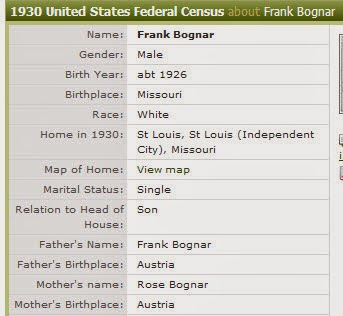
As with most people searching for their heritage, I did a very basic and wide search on Ancestry.com at www.ancestry.com .  The first two results were the 1930 and the 1940 U.S. Census.


No new or surprising information was revealed from these two census listings.  In 1930, the home address was mentioned as 1940 Burd Avenue.  In the 1940 census, the home address was listed at 812 Salisbury Street. Neither home is currently standing.  

Next, I searched on Fold3 at www.fold3.com .  His name appeared in the WWII U. S. Navy Muster Rolls, 1938-1949.  He was aboard the U.S.S. Takanis Bay CVE89.  This page shows the date of his transfer from the escort carrier to the USN Hospital in Seattle, Washington,  This is something that I did not know...just having his date of transfer from ship to hospital is something that I can add to my research, and reference that date when searching for his medical records while in the U.S. Navy. He is listed on line 7, as a Machinist Mate 2nd Class, along with his service number


Fold3 has the muster rolls for the U.S.S. Takanis Bay CVE89 from 1944 through 1946.  Dad's name appears on each muster prior to his transfer to the USN hospital.  

Next, I used Mocavo at www.mocavo.com , a free website for researching genealogy.  They show the Social Security Death Index listing for my Father.  They also mention that there is a memorial listing for him on Find A Grave at www.findagrave.com . No new information for me here.


Family Search at www.familysearch.org  also has the same SSDI and 1940 Census return that the previous websites have in their search results.

My Heritage at www.myheritage,com  repeats the previous results : 1930 and 1940 U. S. Census returns, Find A Grave memorial, and SSDI listing.

GenealogyBank at www.genealogybank.com has the obituary for my Dad from the St. Louis Post-Dispatch, March 2 and 4, 2002 issues.  I do have several copies of this in my family records.


I turned to the Veterans Administration Grave Locator at http://www.cem.va.gov/, and found that Dad was listed correctly with their database, which simply repeats what was in the search results from previous websites.


In addition, the St. Louis Archdiocese http://archstl.org/cemeteries/ has a grave location search engine that helps to find the location of each burial in the cemeteries of the archdiocese, and the ability to reveal what persons share the same burial plot as the deceased.  Here, both of my parents are listed being interred in Section 17A Lot 0129, along with their dates of burial.  


Both People Finders at www.peoplefinders.com and People Smart at www.peoplesmart.com have correctly listed Dad as being deceased, and both mention my Mother as being related, as well as his last location of residence.

World Vital Records at www.worldvitalrecords.com shows a database search result from their public records index.  Showing the last three addresses where my Dad lived, it also includes phone numbers, and naming my Mother as his relative. Of course, there is no new information for me here.


Tribal Pages at www.tribalpages.com doesn't result in any new information on my Dad's life, however, it does show a listing for my grandfather, Frank Bognar, Sr., and his first wife, Anna Springer.  This is a new avenue for my research into that family lineage. But that is for another time.

Conclusion  for now :  The transfer date of my Father from the U.S.S. Takanis Bay to the USN hospital in Seattle, Washington, has been the only new piece of information that I have found during this attempt to update my Dad's story.

Ancestry and it's affiliates are having some server problems this week.  Unfortunately, it has interrupted my on-line searches with additional websites that I wanted to feature here.  There might be a lack of research and browsing this week due to this problem.  With a little luck on their end, this could be resolved shortly.  In the meantime, making good use of other history sources and libraries may prove to be beneficial.  Happy searching to all.

Monday, June 9, 2014

The Life of an Inventor : Lavonious Kenworthy Wynn, OR Don't Believe Every Family Story to be Correct

In some families, there is usually a child that is named for an ancestor; be it a parent, grandparent, great grandparent, or other person that family wished to remember and honor.  My late father-in-law was named Kenworthy Henry Reif.  I knew that his grandfather was Henry Jacob Reif, so there is the repeated "Henry".  But, I did not know where "Kenworthy" had it's origin...was there someone of that name in the family?

After months of working on my husband's family history, I decided to do what I do best....think outside of the box, and work outside of the crate.  This type of research never fails me.  I always come up with something, and indeed, this time I uncovered someone with the name of Kenworthy.

I knew that great grandmother Eliza Hessler Reif had a sister, Emma.  But that was as far as I had gotten into the Hessler family.  Searching  the Illinois State Marriage Index Database, I came across the marriage of Lavonious K. Wynn - Emma Hessler in 1888.  Hmmm.  And the marriage occurred in northern Illinois, in Whiteside County.  Hmmm.  Well, this certainly looks like it could be interesting.  Now I have yet another name to research. But, this wasn't just any person.  It was THE person that I needed to follow through the many records available on-line.

http://www.ilsos.gov/isavital/marriageSearch.do

Sterling Gazette, 1888

Taking this information, I searched on Ancestry.com for Mr. Wynn.  The first result came from the Illinois Deaths and Stillbirths Index, 1916-1947.  

http://search.ancestry.com/
Lavonious Wynn was born in Ohio, and died and was buried in Sterling, Illinois.  He was a widower in 1946 at the time of his death.  His occupation is listed as President of a Laundry Company.  This is little more information than I had before, but what I found on the rest of the page made me jump.  There were a few suggested records that Ancestry.com thought might match this gentleman :


Do you see what I see?  L. KENWORTHY Wynn...... Here is the Kenworthy in this family that I was looking for, listed in the 1910 U.S. Federal Census.  I clicked the link, and BINGO, Lavonious Kenworthy Wynn was married to Emma, living in Sterling, Illinois.

Apparently, my father-in-law was named after his great uncle, brother-in-law of his grandmother, Eliza Hessler Reif.  He must have been an important person in the family to be honored over everyone else in the family when it came to naming my father-in-law.  Now that I found him, I needed to discover what made him so special.  Back to the list of on-line databases that I frequent, I diligently searched for Mr. Wynn.

Lavonious was too young to serve in the military in the Civil War, but he may have served in later years. I searched Fold3.com to uncover more data results.There were no military records, but he was listed in a Cleveland directory of 1880, salesman for F. Bassett Company.  Mr. Wynn did appear in city directories of Des Moines, Iowa from 1892 to 1904.  He resided at The Iliad Hotel, which is no longer standing.


In addition, the name of  L. K. Wynn in the Fort Wayne Journal Gazette, in the 1914 September 7 edition, page 13, volume 38, number 113.  A full page is dedicated to the proof of business prosperity in America, with highlighted comments by leading business men in the United States.

http://www.fold3.com/image/257361646/

My Goodness....it appears Mr. Wynn was a business owner in Sterling, Illinois in 1914...Black Silk Stove Polish Works.  More to research.  How did he get from being in Des Moines in 1904 to Sterling in 1914 as a business owner?

Newspapers are my favorite resource for researching into past lives.  I usually find very interesting information that is not noted in vital records.  ChroniclingAmerica.loc.gov, NewspaperArchive.com, Genealogybank.com and Newspapers.com are my favorite websites for newspaper research.  There are so many others, far too many to name.  For ephemera, I search Mocavo.com.  Additional searching may include Archive.com and InternetArchives at archive.org.

According to a 1963 obit of a nephew of L. K. Wynn, Lewis Wynn,  brother of L. K. invented the polish, but L. K. operated the company, as he had much more experience in sales and marketing. Lewis Wynn passed away of cancer at his home in October of 1904.


Many ads for the Black Silk Stove Polish product were found in so many newspapers.  Here are a few from 1910 posted in the Bemidji Daily Pioneer, Bemidji, Minnesota :


The trademark for the Black Silk Stove Polish was first used on October 9, 1909.  On November 23, 1909 a U. S. Federal Trademark registration was filed for the logo pictured here :

 trademark serial number of 71046083,  currently expired
Note the trademark had been renewed in 1950, as Mr. Wynn passed away in 1946.  Mr. Prescott took over the Black Silk Stove Polish Works in Sterling, Illinois. This trademark became expired on November 3, 1992.

In the Annual Report of the Commissioner of Patents for the Year 1903, Mr. Wynn is listed as having applied for a patent on a cabinet : 

 Friday, January 1, 1904  


Publication: Serial Set Vol. No.4607;  

A patent application was noted in Google.com/patents for Mr. Wynn.  It included an image, dated January 25, 1927, patent number 1,615,319,  of the container product sketch which was submitted for the patent : 


An article from  the Rockford Daily Gazette featured L. K. Wynn and his Black Silk Polish :

Date: Saturday, September 23, 1911  


Paper: Daily Register Gazette (Rockford, IL)  


Page: 11

In other articles, Mr. Wynn was listed as a member of the Executive Committee of the Illinois Elks Association in 1916. The Sterling Illinois Industrial Association, organized in 1907, selected L. K. Wynn as chairman of the committee on Home and Foreign Industries. 

My husband had repeated a story to me, to the best of his recollection, years ago.  It was something about a grandfather or great grandfather who had invented a "shoe black", or black shoe polish, and that a patent had been obtained for the product.  I had dabbled a bit into his ancestors' lives, and found that there were a few German shoemakers, German carpenters, German house painters and German farmers. But, I found no record of a patent for black shoe polish with a connection to this family.

I guess the story became skewed, and the black shoe polish was actually Black Silk Stove Polish.  And, it was not invented by Lavonious Kenworthy Wynn, a great uncle....not a great grandfather, but his brother, Lewis Wynn.  Nevertheless, it is an interesting story, to say the least.

Friday, May 16, 2014

What is FamilySearch Wiki and Will it Help My Research Problems?

You may have heard about Wikipedia ( http://www.wikipedia.org/ )....a free on-line encyclopedia where topics can be searched using a wide variety of international languages.  FamilySearch has a similar learning webpage entitled FamilySearch Wiki ( https://familysearch.org/learn/wiki/en/Main_Page ).


 FamilySearch Wiki answers the question, What is the Wiki ?

 The Wiki is about finding records that may have been generated about your ancestors and the places in which the records might be found. It is a vast record depository of the paper trail that people leave behind long after they are gone. The Wiki has records from the United States as well as from 244 countries.  Here you will be able to find documents such as census records, marriage records, birth records and death records and much more. Probate documents are often very informative and may help you in your search.  There is an extensive list of United States military records on the wiki .    

Search by place or topic by clicking on a map, as seen below:


OR learn how to search your family history, simply by choosing from the many research helps offered, from getting suggestions about organizing your family history, choosing a database to file your family facts or learn about basic research principles to keep you on track.

Using the Wiki Tools, you can view many articles written regarding online library catalogs, international websites, and internet repositories, just to name a few topics.  

Most importantly, there are links to contact research help specialists at FamilySearch.  I have never contacted them....yet.  But, sometime in the future if I am unable to break down a brick wall in my research, I just might take advantage of these specialists.  I suggest that you do, too.

You can also share your information and suggestions regarding research in a particular topic or country.  Adding your own "user page" could help to keep yourself more organized, too,  There are Talk Pages to share your ideas, or communicate with a specific user.  Sign up for a Watch List, and be notified when new content has been added to topics that interest you.  Browse the WikiProjects lists and join one if you'd like, or establish a new one yourself.  Submit an article regarding a particular topic in which you have expertise, or add to the content of articles already featured. 

Ever have trouble with geographic places with the same name?  The category "Ambiguous Place Names"     (https://familysearch.org/learn/wiki/en/Category:Ambiguous_place_names) can be a big help for you.  I searched for the location "Georgia".  The result made me pleasantly satisfied :

Georgia may refer to:
  • Georgia (country), formerly Georgian Soviet Socialist Republic (SSR) 1921-1991; and Democratic Republic of Georgia 1918-1921.
  • Georgia (state), a state in the southern United States, and formerly one of the British colonies in North America.
Georgia may also refer to other local jurisdictions:
And, of course there is the wonderful topic : Family History For Beginners
From evaluating the family history that you know, to starting the research for the information that you want to know....this is the ultimate in self-learning, step-by-step instructions to get you started in your quest to find your ancestors and their life stories.  Learn how to properly document and cite the sources of your research results. And, don't forget to review the genealogy and legal terminology categories.  It helps to know what you're talking about, right?  

I can go on, and on, about FamilySearch Wiki.  But, I won't be able to cover everything in this blog.  Try it yourself, and see what you can learn, and maybe contribute, to this FREE resource.  It's just waiting for you to experience the fascinating world of learning.